
 at
at 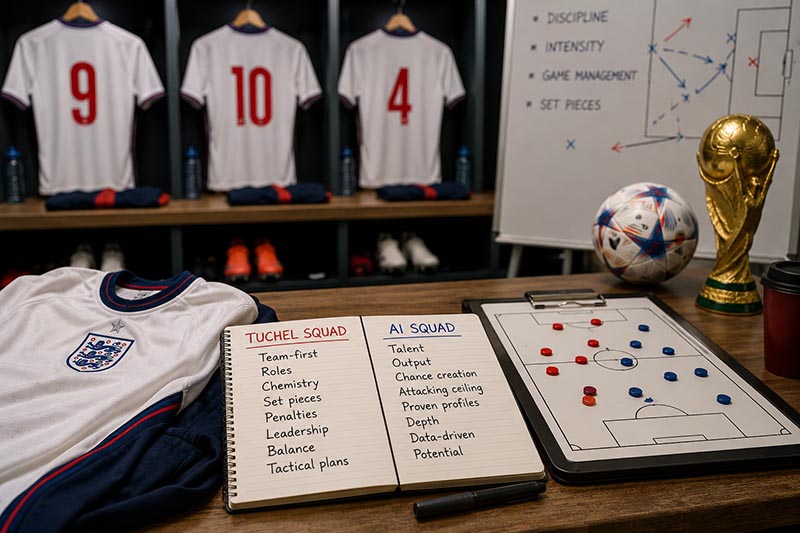
Thomas Tuchel has left big names at home, but an AI-backed alternative squad suggests England’s World Cup debate is really about star power versus tournament utility.
The Machine Wanted More Familiar Faces
England’s World Cup squad has already given fans the traditional pre-tournament pastime: arguing loudly before a ball has been kicked.
Thomas Tuchel named his 26-man group for the 2026 World Cup with Harry Kane as captain, but the headline was who missed out. Phil Foden, Cole Palmer, Trent Alexander-Arnold and Harry Maguire were all left behind, while Ivan Toney, Djed Spence, Jarell Quansah, Nico O’Reilly, Morgan Rogers and Jordan Henderson made the cut.
That was punchy enough. Then came the data crowd.
A rival selection from football AI firm PLAIER kept only 16 of Tuchel’s 26, meaning 10 of England’s actual picks would have been swapped out. The AI list brought in Nick Pope, Trent Alexander-Arnold, Lewis Dunk, James Tarkowski, Harry Maguire, Lewis Hall, Curtis Jones, Cole Palmer, Phil Foden and Adam Wharton. Out went James Trafford, Dan Burn, Ezri Konsa, Nico O’Reilly, Jarell Quansah, Djed Spence, John Stones, Kobbie Mainoo, Jordan Henderson and Morgan Rogers.
So, yes, the spreadsheet has a soft spot for Foden and Palmer. Plenty of England fans may be nodding along already.
Tuchel Is Backing Roles Over Reputations
The split is not random. PLAIER says its platform scans a huge football database, covering more than 390,000 players from over 200 countries, and uses AI to assess players, teams and future fit. Sky Sports has also reported that PLAIER has worked with Premier League clubs and provides guidance on transfers, squad cohesion and coaching decisions.
That matters because the AI squad reads like a model built to preserve output, depth and proven player profiles. It likes Trent Alexander-Arnold’s chance creation. It likes Phil Foden and Cole Palmer’s attacking ceiling. It likes Harry Maguire, Lewis Dunk and James Tarkowski’s defensive familiarity and aerial value.
Tuchel, meanwhile, has picked a tournament squad rather than a fantasy draft. He has talked up chemistry, trust, set pieces, penalties and players who can solve specific match situations. That helps explain Ivan Toney, whose Saudi Pro League goals and penalty-box skill give England a late-game weapon, even if his recent England minutes are thin.
For bettors, that is the useful part. England’s price is not just about whether Harry Kane, Jude Bellingham, Declan Rice and Bukayo Saka start. It is about whether Tuchel’s bench has enough answers when a knockout game turns ugly after 70 minutes.
The Betting Angle Is Volatility, Not Just Talent
The AI version of England probably feels sexier. Foden, Palmer and Trent are the sort of players who shorten highlight reels and tempt punters toward player props. Tuchel’s version is less glossy, but it may be built for the boring little details that decide tournaments.
That creates a market problem.
England may still attract heavy public money because the squad contains Kane, Bellingham, Rice and Saka. Reuters described England as one of the main favourites, and the Three Lions have been drawn in Group L with Croatia, Ghana and Panama. Their group schedule starts against Croatia in Dallas on June 17, followed by Ghana in Boston on June 23 and Panama in New York/New Jersey on June 27.
But bettors should be careful with the “England are stacked” shortcut. Tuchel has removed several high-variance creators and leaned into balance, leadership and scenario management. That could help England grind through tight games. It could also leave them short of imagination if Bellingham or Saka is crowded out.
The sharper read is this: England may be better suited to low-margin tournament football than to running up scores. That makes outright betting, group winner markets and clean-sheet bets more interesting than blindly chasing goal-heavy wagers.
The AI Squad Exposes England’s Two Identities
The funniest part of the AI debate is that both sides are reasonable.
The machine sees a missed chance to take more elite technical talent. It wants Palmer, Foden and Trent in the building, because most teams would crawl through broken glass for one of them. Tuchel sees the same names and asks where they fit, who they displace and whether the dressing room gains more than the tactics board loses.
That is the real England World Cup story. This is not AI versus common sense. It is probability versus personality.
Online bettors should treat the row as a warning against lazy pre-tournament narratives. England are not simply weakened because three famous names are missing. They are not automatically smarter because a coach said “chemistry” a lot, either.
Thomas Tuchel has made a bet of his own. He has wagered that roles, set pieces, penalties, leadership and squad harmony will travel better across North America than a deeper pile of No. 10s.
If he is right, England may look controlled rather than thrilling. If he is wrong, every Cole Palmer goal compilation and Phil Foden touch map will become a national grievance by breakfast.